

What Are Runes in Summoners War and Why They Matter
Runes are equipment items that dramatically increase a monster’s stats in Summoners War. Without runes, even the strongest monsters perform poorly. With the right rune build, an average monster can outperform a natural 5★ unit. Runes determine your damage output, survivability, speed, and overall effectiveness in both PvE and PvP content.
How Rune Stats Affect Monster Performance
Rune stats directly impact how often your monster moves, how hard it hits, and how long it survives. Speed determines turn order, attack increases damage, HP and defense improve tankiness, and accuracy allows debuffs to land consistently. Poor rune stat choices can cripple a monster regardless of its skill set.
Flat Stats vs Percentage Stats: Which Should You Use?
Percentage stats (%HP, %ATK, %DEF) scale with a monster’s base stats and are almost always better than flat stats. Flat stats are only acceptable early game or on very specific monsters. As a rule, prioritize percentage stats for slots 2, 4, and 6 whenever possible.
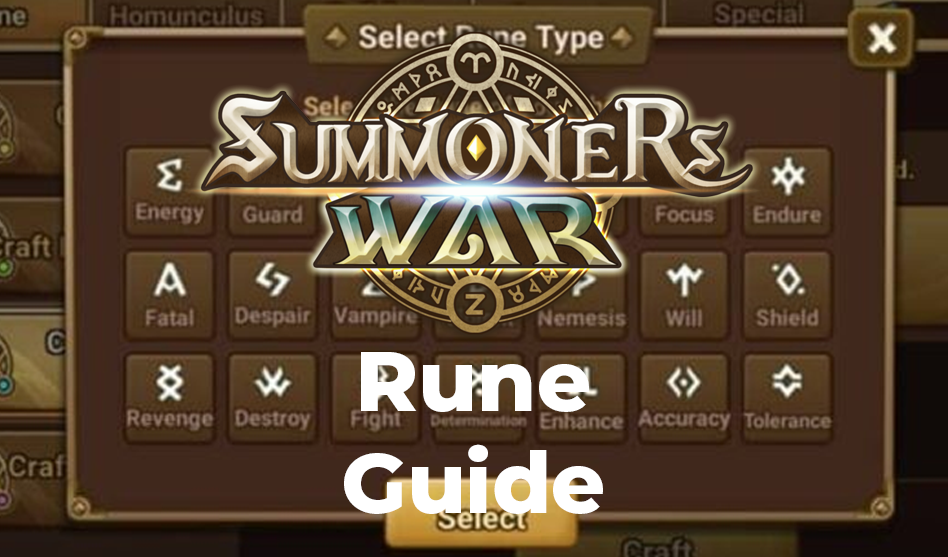
The 23 Rune Types in Summoners War
Runes are the foundation of every monster’s power in Summoners War. Each rune type provides a unique bonus when a specific number of runes are equipped, allowing players to customize monsters for damage, speed, tankiness, or utility.
Below is a detailed breakdown of all 23 rune types, their effects, and how they’re commonly used.
1. Energy Rune
Set Requirement: 2
Effect: HP +15%
Energy runes increase a monster’s survivability by boosting maximum HP. They are commonly used on tanks, supports, and early-game monsters due to their simplicity and availability.
2. Guard Rune
Set Requirement: 2
Effect: DEF +15%
Guard runes improve defense, reducing incoming damage. They are useful for bruisers and defense-scaling monsters.
3. Swift Rune
Set Requirement: 4
Effect: SPD +25%
Swift runes are one of the most important rune sets in the game. Speed determines turn order, making Swift essential for supports, controllers, and early-game progression.
4. Blade Rune
Set Requirement: 2
Effect: Critical Rate +12%
Blade runes help damage dealers reach critical rate thresholds. They are often paired with Rage or Fatal sets, especially in early to mid-game builds.
5. Rage Rune
Set Requirement: 4
Effect: Critical Damage +40%
Rage runes maximize burst damage. They are ideal for nukers, boss damage dealers, and cleave teams where killing enemies quickly is the priority.
6. Focus Rune
Set Requirement: 2
Effect: Accuracy +20%
Focus runes increase debuff reliability. They are commonly used on debuffers, controllers, and PvE monsters that need to land consistent harmful effects.
7. Endure Rune
Set Requirement: 2
Effect: Resistance +20%
Endure runes reduce the chance of receiving debuffs. While resistance is unreliable, Endure can be useful on niche builds or resistance-scaling monsters.
8. Fatal Rune
Set Requirement: 4
Effect: ATK +35%
Fatal runes provide raw attack power and are excellent for early-game damage dealers before players transition into Rage or Violent sets.
9. Despair Rune
Set Requirement: 4
Effect: Stun Rate +25%
Despair runes add crowd control to AoE attacks. They are commonly used on monsters with multi-target skills in PvP and ToA content.
10. Vampire Rune
Set Requirement: 4
Effect: Life Drain +35%
Vampire runes allow monsters to heal based on damage dealt. They are popular on solo monsters, bruisers, and sustain-focused builds.
11. Violent Rune
Set Requirement: 4
Effect: 22% chance to gain an extra turn
Violent runes are among the strongest sets in the game. Extra turns allow faster skill cycling and unpredictable combat outcomes, dominating mid- to late-game PvP.
12. Nemesis Rune
Set Requirement: 2
Effect: ATK Gauge +4% per lost HP
Nemesis runes boost turn gauge when damage is taken. They are commonly used on healers and supports to cut in and respond quickly.
13. Will Rune
Set Requirement: 2
Effect: Immunity for 1 turn
Will runes protect monsters from debuffs at the start of battle. They are essential in PvP to counter control teams and speed cleaves.
14. Shield Rune
Set Requirement: 2
Effect: Ally shield for 3 turns (15% of HP)
Shield runes provide team-wide protection at battle start. They are effective in Siege, Arena defense, and cleave-resistant teams.
15. Revenge Rune
Set Requirement: 2
Effect: Counterattack +15%
Revenge runes add counterattack potential. They work well on monsters with strong basic attacks or on bruisers in prolonged fights.
16. Destroy Rune
Set Requirement: 2
Effect: Enemy MAX HP −4% (up to 30% of damage dealt)
Destroy runes permanently reduce enemy HP, making them valuable against sustain teams and high-HP tanks in long battles.
17. Fight Rune
Set Requirement: 2
Effect: Ally ATK +8%
Fight runes provide a passive team attack boost. They are commonly stacked on support monsters in PvE speed teams.
18. Determination Rune
Set Requirement: 2
Effect: Ally DEF +8%
Determination runes increase team defense and are useful in tanky compositions and guild content.
19. Enhance Rune
Set Requirement: 2
Effect: Ally HP +8%
Enhance runes boost team survivability and are often used in combination with Shield and Determination runes.
20. Accuracy Rune
Set Requirement: 2
Effect: Ally Accuracy +10%
Accuracy runes help teams land debuffs more reliably, particularly useful in PvE and control-heavy strategies.
21. Tolerance Rune
Set Requirement: 2
Effect: Ally Resistance +10%
Tolerance runes increase team resistance. While situational, they can be useful against heavy debuff teams.
22. Seal Rune
Set Requirement: 2
Effect: Seal Rate +25%
Seal runes increase the chance to apply the Seal effect, preventing passive skills from activating. They are especially impactful in PvP.
23. Intangible Rune
Set Requirement: Special
Effect: Can replace any rune in an N-rune set
Intangible runes are extremely flexible. They allow players to complete rune sets without meeting the usual slot requirements, enabling advanced optimization and high-efficiency builds.
How to Select Good Runes in Summoners War
Selecting good runes is one of the most important skills in Summoners War. Farming runes is only half the battle—the real progress comes from knowing which runes are worth keeping, upgrading, and equipping.
A good rune is not just about rarity or star grade; it’s about stats, synergy, and efficiency.
Step 1: Check the Main Stat First
The main stat determines whether a rune is usable at all.
Fixed Main Stat Slots
-
Slot 1: ATK (Flat)
-
Slot 3: DEF (Flat)
-
Slot 5: HP (Flat)
These slots are judged mostly by sub stats.
Flexible Main Stat Slots (Very Important)
-
Slot 2: SPD, ATK%, HP%, DEF%
-
Slot 4: CRI Rate%, CRI Dmg%, ATK%, HP%, DEF%
-
Slot 6: ATK%, HP%, DEF%, Accuracy%, Resistance%
If any rune rolls flat stats, they are usually sell candidates (especially mid to late game).
Step 2: Evaluate the Sub Stats
Sub stats often matter more than the main stat in determining rune quality.
High-Value Sub Stats
-
Speed (SPD)
-
ATK%, HP%, DEF%
-
CRI Rate% / CRI Dmg% (for damage dealers)
Situational Sub Stats
-
Accuracy% (for debuffers)
-
Resistance% (for supports)
Low-Value Sub Stats
-
Flat stats on scaling slots
-
Random stats that don’t fit a role
A rune with 3–4 useful sub stats is far more valuable than a rune with mixed or conflicting stats.
Step 3: Look for Stat Synergy
Good runes have stats that work together.
Examples of Good Synergy
-
ATK% + CRI Rate% + CRI Dmg% (damage dealers)
-
HP% + DEF% + Resistance% (tanks/supports)
-
SPD + Accuracy% (controllers and debuffers)
Poor Synergy
-
ATK% + Resistance% + flat DEF
-
CRI Dmg% with no CRI Rate
-
Speedless runes for turn-based monsters
A rune with synergy will outperform a higher-stat rune with mismatched stats.
Step 4: Consider Rune Rarity & Star Grade
Star Grade (1★–6★)
-
Determines maximum stat values
-
6★ runes are almost always preferred
Rarity (Blue, Purple, Legendary)
-
Determines how many sub stats and upgrades a rune can receive
-
Legendary runes have the highest potential—but only if the stats roll well
A 6★ blue rune with great sub stats can be better than a 5★ legendary with poor stats.
Step 5: Upgrade Smartly Before Deciding
Never judge a rune at +0 alone.
Efficient Testing Method
-
Upgrade to +3 or +6
-
Check where the rolls go
-
Stop upgrading if the rune rolls poorly
Avoid taking runes straight to +15 unless they’ve proven their value.
Step 6: Think About Monster Role & Game Mode
A “good” rune depends on who will use it.
PvE
-
Speed tuning
-
Consistent stats
-
Accuracy for debuffs
PvP
-
Speed contests
-
High efficiency
-
Focused stat builds
Always ask:
-
Is this rune for damage, support, control, or tanking?
-
Does it fit a specific monster or team?
Step 7: Use Rune Score as a Reference (Not a Rule)
Rune score is helpful for:
-
Quick filtering
-
Comparing similar runes
But:
-
High score ≠ correct rune for every monster
-
Lower score runes can be better with proper synergy
Common Mistakes to Avoid
-
Keeping flat stat runes on slots 2/4/6
-
Upgrading every legendary rune
-
Ignoring speed
-
Powering to +15 too early
-
Keeping runes “just in case”
Final Rule of Thumb
A good rune:
-
Has the correct main stat
-
Rolls useful sub stats
-
Has stat synergy
-
Fits a specific monster role
-
Justifies the mana investment
If a rune fails two or more of these checks, it’s usually better to sell it.
How to Power Up Runes in Summoners War
Powering up runes is one of the most important progression systems in Summoners War. Upgrading a rune increases its main stat and improves or unlocks sub stats, making your monsters significantly stronger.
Runes can be powered up from +0 to +15 using Mana Stones.
How Rune Power-Ups Work
Power-Up Milestones
Runes gain improvements at specific levels:
-
+3
-
+6
-
+9
-
+12
-
+15
At each milestone:
-
The main stat increases
-
A new sub stat is added or
-
An existing sub stat is upgraded
What happens depends on the rune’s rarity.
Rune Rarity and Sub Stat Progression
🔵 Blue (Rare) Runes
- Start with 2 sub stats
-
Existing sub stats increase only till +6
At:
- +3 → Existing sub stat upgraded
- +6 → Existing sub stat upgraded
- +9 → New sub stat added (now 3 total)
- +12 →New sub stat added (now 4 total)
🟣 Purple (Hero/Epic) Runes
-
Start with 3 sub stats
- Existing sub stats increase only till +9
- At:
- +3 → Existing sub stat upgraded
- +6 → Existing sub stat upgraded
- +9 → Existing sub stat upgraded
- +12 →New sub stat added (now 4 total)
🟡 Gold (Legendary) Runes
-
Start with 4 sub stats
-
Can be powered up to +12
-
At:
-
+3 → Existing sub stat upgraded
-
+6 → Existing sub stat upgraded
-
+9 → Existing sub stat upgraded
-
+12 → Existing sub stat upgraded
-
Legendary runes receive four full sub stat upgrades, making them the strongest and most desirable runes in the game.
What Happens at +15?
At +15, no new sub stats are added.
-
Only the main stat increases
-
The cost is very high
-
Efficiency gain is smaller compared to earlier upgrades
This is why many players delay +15 upgrades until they are sure a rune is worth it.
Sub Stat Upgrade Mechanics
When a rune upgrades a sub stat:
-
The stat is chosen randomly
-
The upgrade value varies within a range
-
Multiple upgrades into the same stat are called “rolls”
Desirable Rolls
-
Speed
-
Percentage stats (ATK%, HP%, DEF%)
-
CRI Rate / CRI Dmg for damage dealers
Important Things Many Players Miss
Flat vs Percentage Stats
-
Flat stats are weaker on slots 2, 4, and 6
-
Percentage stats scale better with monster base stats
Rune Grade vs Rune Rarity
-
Rarity determines how many sub stats and upgrades a rune can have
-
Grade (1★–6★) determines how high the stats can roll
-
A 6★ blue rune can be stronger than a 4★ legendary rune
Efficient Rune Power-Up Strategy
-
Check the main stat first
-
Upgrade to +3 or +6
-
Evaluate sub stat rolls
-
Continue only if the rune rolls well
-
Commit to +12 or +15 only for high-quality runes
Final Tips
-
Don’t upgrade every rune you get
-
Stop early if rolls are bad
-
Legendary does not automatically mean good
-
Mana efficiency is just as important as rune quality
Common Mistakes to Avoid
- upgrading every rune you find (rather sell unless if it’s a 6★ rune),
- chasing sets over stats,
- investing heavily in early-game runes that will soon be replaced and
- not putting up enough runes to complete a set
Rune Scores in Summoners War
What Is a Rune Score?
A Rune Score is a numerical value that represents how powerful and efficient a rune is based on its stats.
The higher the rune score, the stronger the rune’s overall stat efficiency compared to an ideal rune.
Rune scores are commonly used to:
-
Quickly evaluate rune quality
-
Compare two similar runes
-
Decide whether a rune is worth upgrading, keeping, or selling
Simply put: Rune Score = Rune Value
How Rune Scores Increase
Rune scores only increase when:
-
New sub stats are added
-
Existing sub stats increase
Every time a rune gains stats (especially percentage stats or Speed), its score rises accordingly.
Important Warning: Don’t Blindly Power Up to +15 ⚠️
One of the most common mistakes players make is powering runes all the way to +15 without evaluating them first.
Why This Is a Problem
-
Powering a rune to +15 is very expensive
-
A bad rune remains bad even at +15
-
Mana spent on weak runes slows overall progression
Smarter Upgrade Strategy
Instead of immediately going to +15:
-
+3 / +6 → Check if the rune rolls desirable stats
-
+9 / +12 → Decide if the rune is worth keeping
-
+15 → Only upgrade if the rune has proven high value
If the rune rolls poorly (e.g. flat stats on important slots), it’s usually better to stop early and sell it.
What Makes a Rune Have a High Score?
A rune’s score increases more efficiently when it has:
-
High Speed rolls
-
Percentage stats (ATK%, HP%, DEF%)
-
Multiple upgrades into the same useful stat
-
Good stat synergy (e.g. CRI Rate + CRI Dmg for damage dealers)
Stats That Lower Rune Efficiency
-
Flat stats on slots 2, 4, and 6
-
Resistance or Accuracy on monsters that don’t need them
-
Random stat distribution with no synergy
Rune Score vs Monster Usage
A high rune score does not always mean the rune is useful for every monster.
For example:
-
A high-score rune with Resistance may be excellent for supports
-
That same rune may be terrible for damage dealers
Rune score measures power, not purpose.
Always consider:
-
Monster role (damage, support, control)
-
Game mode (PvE vs PvP)
-
Team composition
Early Game vs Late Game Rune Scores
Early Game
-
Lower rune scores are acceptable
-
Focus on completing sets and main stats
-
Efficiency matters less than progression
Mid to Late Game
-
Rune scores become much more important
-
Only high-efficiency runes are worth upgrading
-
Mana management becomes critical
Rune Scores Are a Tool, Not a Rule
While rune scores are extremely helpful, they should not be followed blindly.
Use rune scores to:
-
Filter obvious bad runes
-
Save time when evaluating drops
-
Improve rune quality over time
But always apply common sense and monster needs before selling or upgrading a rune.
Final Tips for Managing Rune Scores
-
Check rune scores before committing to +15
-
Speed rolls matter more than almost any other stat
-
Sell early to save mana
-
A slightly lower score rune with perfect synergy can outperform a higher score rune
Understanding Rune Slots in Summoners War
In Summoners War, each rune has six possible slots (1–6).
Every slot has specific main stats it can roll, while sub stats are shared across most slots. Understanding which stats can appear where is essential for efficient rune farming and monster optimization.
Important Rule:
When you acquire a rune, it will roll one main stat only, chosen randomly from the allowed main stats for that slot. Sub stats are rolled separately and can vary widely.
Slot 1 – Attack Rune
Main Stat
-
ATK (Flat) – always fixed
Slot 1 is simple: it always rolls flat ATK as the main stat. This stat cannot change.
Possible Sub Stats
-
SPD
-
ATK%
-
CRI Rate %
-
CRI Dmg %
-
HP (Flat)
-
HP%
-
DEF (Flat)
-
DEF%
-
Accuracy %
-
Resistance %
Slot 2 – Speed & Scaling Slot
Main Stats (Properties)
Slot 2 is one of the most important slots because it can roll Speed.
-
SPD
-
ATK%
-
HP%
-
DEF%
-
ATK (Flat)
-
HP (Flat)
-
DEF (Flat)
Possible Sub Stats
-
ATK (Flat)
-
ATK%
-
HP (Flat)
-
HP%
-
DEF (Flat)
-
DEF%
-
CRI Rate %
-
CRI Dmg %
-
Accuracy %
-
Resistance %
Slot 3 – Defense Rune
Main Stat
-
DEF (Flat) – always fixed
Like Slot 1, Slot 3 has a fixed main stat and cannot roll percentages or speed.
Possible Sub Stats
-
HP (Flat)
-
HP%
-
ATK (Flat)
-
ATK%
-
DEF%
-
SPD
-
CRI Rate %
-
CRI Dmg %
-
Accuracy %
-
Resistance %
Slot 4 – Critical & Damage Slot
Main Stats (Properties)
Slot 4 is crucial for damage dealers.
-
CRI Rate %
-
CRI Dmg %
-
ATK%
-
HP%
-
DEF%
-
ATK (Flat)
-
HP (Flat)
-
DEF (Flat)
Possible Sub Stats
-
CRI Rate %
-
CRI Dmg %
-
ATK%
-
HP%
-
DEF%
-
ATK (Flat)
-
HP (Flat)
-
DEF (Flat)
-
Accuracy %
-
Resistance %
Slot 5 – Health Rune
Main Stat
-
HP (Flat) – always fixed
Slot 5 always rolls flat HP as its main stat.
Possible Sub Stats
-
ATK (Flat)
-
ATK%
-
HP%
-
DEF (Flat)
-
DEF%
-
CRI Rate %
-
CRI Dmg %
-
Accuracy %
-
Resistance %
Slot 6 – Power & Utility Slot
Main Stats (Properties)
Slot 6 offers strong scaling and utility options.
-
ATK%
-
HP%
-
DEF%
-
Accuracy %
-
Resistance %
-
ATK (Flat)
-
HP (Flat)
-
DEF (Flat)
Possible Sub Stats
-
ATK%
-
HP%
-
DEF%
-
ATK (Flat)
-
HP (Flat)
-
DEF (Flat)
-
Accuracy %
-
Resistance %
-
CRI Rate %
-
CRI Dmg %
Key Rune Slot Rules to Remember
-
Slots 1, 3, and 5 have fixed main stats
-
Slot 1: ATK (Flat)
-
Slot 3: DEF (Flat)
-
Slot 5: HP (Flat)
-
-
Slots 2, 4, and 6 are flexible
-
These slots can roll percentage stats, Speed, Accuracy, or Resistance
-
This is where most rune value comes from
-
-
Each rune rolls only ONE main stat
-
The stat is randomly chosen from the allowed list for that slot
-
Sub stats are rolled separately and upgraded as the rune levels up
-

I started writing down one thing at the end of every day — what I actually managed to do. Not a to-do list, not plans. Just one small win. It’s surprising how quickly it shifts your perspective.
This is an excellent guide! Extremely comprehensive and easy to understand. An ACTUAL in depth guide to this critical aspect of the game.